Taj Mahal: Architecture of Love
By Rita Devgan, BLA
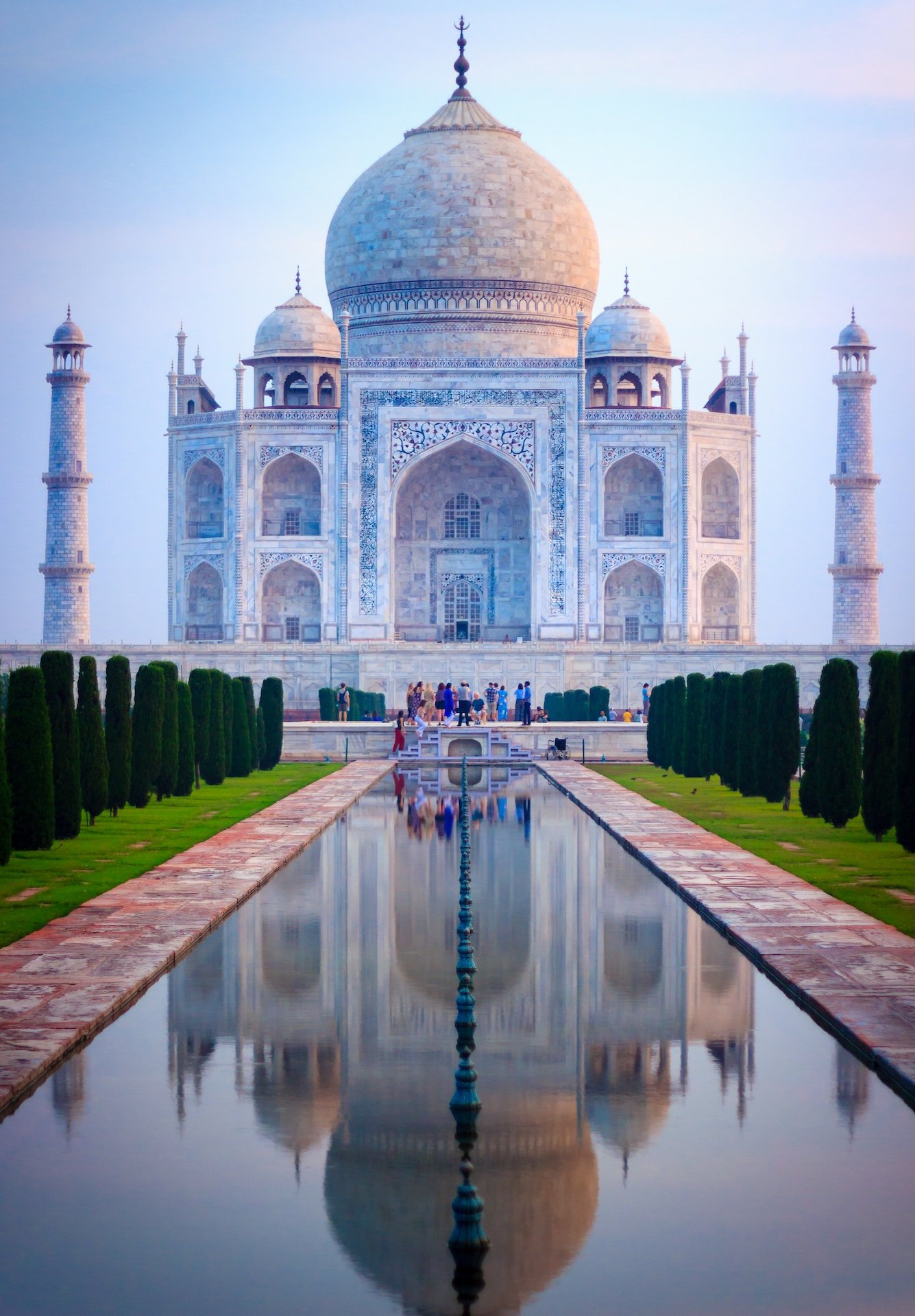
Many shades of Taj. Photograph by Malpaniashutosh, Wikimedia Commons.
If you ask someone what building in the world most suggests love and devotion, their first answer will probably be the same as Wikipedia’s: The Taj Mahal. The Taj is the must-see for everyone who travels to India.
You can feel this monumental expression of love as soon as you enter the Taj Mahal’s enclosure, through its grandeur and peaceful order. The original design even included fruit trees to welcome weary travellers and provide some sustenance.
The emperor Shah Jahan built this mausoleum in 1632, for the body of his beloved wife who died giving birth to their fourteenth child. The site had been selected so that the Shah could see it from Agra Fort, down-river, which they called home. The adjacent buildings were built to house his own body, with a view of his wife for evermore and as an expression of his eternal devotion and protection.
Much later, during the Indo-Pakistan tensions, there was talk of covering the whole main tomb with a cloth to prevent it from being attacked, since moonlight reflected from its white marble made it an easily identified target. Then there was concern that it might be bombed accidentally.
•••••
I left India as a baby, but I still maintained a tenuous relationship with its culture, partly due to stories around the dinner table. And over the years, I heard more stories about this beautiful glistening jewel of a building and its majestic campus that sits on a prominent location on the Yamuna River in the arid desert in Agra.
When I finally visited India, “saturated” is the only word to describe the intensity of my experience upon arrival. In fact, it is the most saturated country in all my travelling experience—from colour in clothing that filled my vision with a splatter rivalling a paint store explosion, to the ornamentation on the simplest of items and the packaging of local wares that burst off the grocer’s shelves.
The streets are filled with cars, trucks, scooters, pulled rickshaws, motorized rickshaws, and animals—from cows to camels to donkeys to elephants—everywhere, all day long. The roadside is consumed by layers of pedestrian space, shops, huts, and rabbit warrens of lanes leading to housing zones with houses at every scale.
India’s roadways are often described as the “ultimate democracy” in that all manner of vehicles and animals of all sizes dash madly or lumber casually, making up their own rules of the road along the way.
A game of “chicken” ensues as a tractor overloaded with hay and workers drives head-on into the oncoming traffic until one side relents and gives way. It is a harrowing honking environment, and it doesn’t always work out. My dad would NOT let us go into traffic in a personal vehicle. It was his assessment that a tour bus from Delhi and back would be safest.
Suffice it to say that I experienced culture shock when I returned to downtown Toronto, finding it empty and barren in comparison.
Our ground travel to Agra was a treacherous few-hours drive. The first glimpse of the Taj’s main building, which appeared in the mirrored surface of the reflecting pool, can only be described as a precious “gem,” in stark contrast to the traffic chaos.
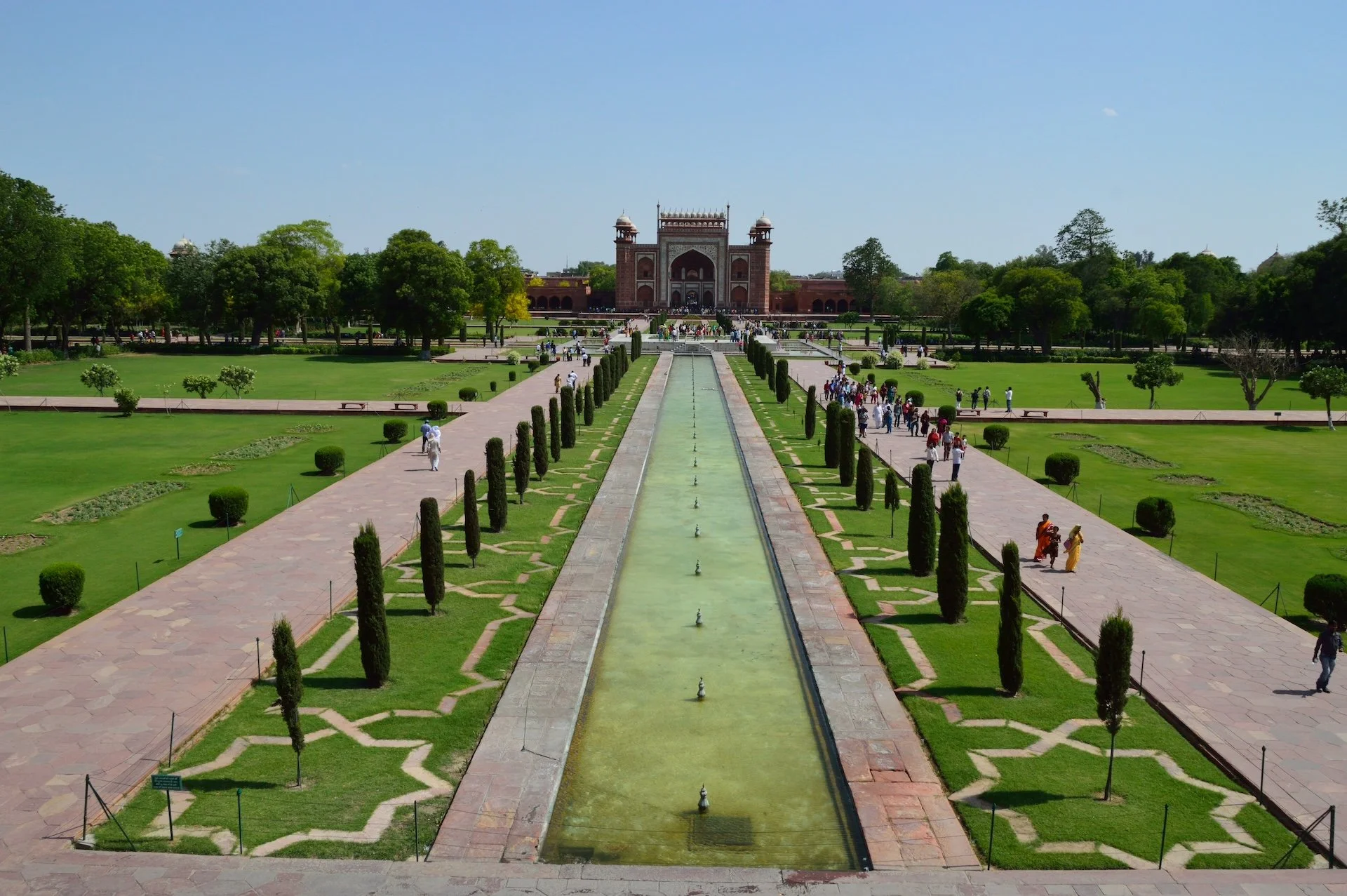
The Taj Mahal, photographed for Wiki Loves Monuments 2014 in India. Photograph by Biswarup Ganguly, Wikimedia Commons.
Entering the grounds through an ornate gate structure, we were welcomed by the Charbagh Garden, with Persian Islamic and Indian influences, typically split into four equal sections by walkways and flowing water. The peacefulness is formally conveyed by a strict order of raised flower beds and trees aligned in rows. But a visitor’s eyes are guided first to the main structure whose marble glows pink at dawn, white at high noon and golden in the evening light.
Our guide quickly conveyed the complexity of the original construction, in its use of 20,000 artisans who took 22 years to build it. He pointed out that 22 years may have been the extent of most labourers’ life. A thousand elephants were used to drag the marble from the far-off quarry to the site. They then had to build a spiral ramp to drag materials up to the building heights in the absence of scaffolding technology. Also, the many rumours that the architect’s and artisans’ hands were cut off so they could not build a beautiful copy elsewhere, are incorrect. In fact, they may have formed an early design-build team to make other landmarks for the feudal lords of the time.
The main structure is surrounded by four minarets at the corners of the raised platform it sits on. The minarets are angled outward from bottom to top, so that they would fall away from the treasured mausoleum in case of an earthquake that might cause them to tumble onto the tomb below. The outward-leaning minarets also create an optical illusion. Because the building is actually wider at the top than the bottom, it minimizes the sense of its height, looking up—an early use of foreshortening. The dedication to maintaining an intimate scale is helped by surface calligraphy which is larger at the top, to appear to be the same size all the way up.
The sense of intimate scale created by these illusory effects helps in generating a sense of love. This sense was made especially clear when Princess Diana of England was photographed there on her first trip to India, alone. The whole world gasped. Her being so obviously alone shocked us into realizing her marriage was in trouble despite the optics to hide that horribly sad fact.
Unfortunately, there are signs of decay and marauding apparent around the main building. The finial at the top of the dome was originally pure gold but plundering or acid rain has caused them to be replaced with replica ornamentation. The inlaid precious stones of jade, amethyst and turquoise that once covered the walls have been largely carved out over time.
The preservation of this Unesco Heritage Site is ongoing, as the platform it sits on is supported by ebony and mahogany piles driven into the silt and sand to keep the base from shifting. It requires the river water to remain plentiful enough to keep it as stable as the concrete it supports.
As the drive to preserve this monument to love and devotion continues, so does the indescribable draw it provides to India.