Vocation, Big Picture, & Integration: How Spirituality Enters Architectural Education
By Julio Bermudez
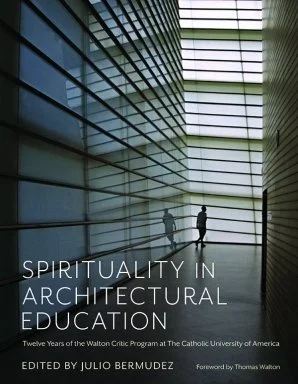
Spirituality in Architectural Education. The Catholic University of America Press, 2023.
Julio Bermudez's book Spirituality in Architectural Education: Twelve Years of the Walton Critic Program at The Catholic University of America (published by The Catholic University of America Press in 2023) is available from the publisher.
It is hard not to feel demoralized, disempowered, or skeptical about the world today. Who doesn’t want things to be better or work towards improving them? But the path to a new and better reality cannot be one of avoidance, appeasement, subversion, or adoption of some sexy new idea. Nor can we fall back to easy reactionary models. Instead, the path forward should come, at least initially, from inside ourselves as individuals and society. And, what better place to start than in an architectural classroom or studio devoted to drawing those ideas, visions, and more out of students? Isn’t this what “education” is all about anyway?
Originating in the Latin word “educare,” education means “to draw out.” In order to teach/learn, something inside the student must be brought forward, probably from the deep — otherwise, it would have surfaced already! The attention to the inner world of students that a spirituality grounded architectural education depends on and enables naturally aligns with this goal. But, how do we most successfully occasion such “drawing”? Should the teacher invite or provoke such coming out? Should it be a “calling”? Is this the vocation we usually talk about? These are all questions that a spirituality-minded education must deal with. One thing is clear. An education that genuinely draws out is not a one-time, individualistic, and secluded event but a process involving others that takes time, patience, openness, care, and all we have been discussing thus far.
But as much as there is more to architecture schooling than learning to put a building together, there is a lot more to a spirituality-growing architectural education than bringing out a student’s inner world.
There is also, and significantly, the questioning of today’s reality and the envisioning of better ones that can only be done in conjunction with others. None of this can be done unless “big questions” and a “big picture” are invited in. Compassion, patience, social bonding, authenticity, and the rest cannot be demanded or intellectually learned but must be organically, lovingly, patiently grown. Such developments would best happen if integrated and not separated from the intense educational experience students of architecture undergo. Keeping spiritual and ordinary lives apart is not only artificial but has negative consequences. Social philosopher and architectural critic Lewis Mumford warned us about it 80 years ago:
the segregation of the spiritual life from the practical is a curse that falls impartially upon both sides of our existence.
Don’t we want to graduate students versed in the spiritual dimension of professing architecture? In my book, I present the work that the Walton Studio has been doing towards this goal for twelve years. I hope this experience assists us all in the never-ending task of learning (and teaching) architecture.