Ecotheology
By Roberto Chiotti, OAA, FRAIC

Fallen leaves, Ontario. Photo: The Right Angle Journal.
Ecotheology is a form of theology that focuses on the interrelationships of religion, humans, and nature, in an attempt to inspire an appropriate and effective response to the ecological crisis facing humanity beyond what science and education can offer. Major contributors such as cultural historian, Rev. Thomas Berry, CP suggest that we are in trouble right now because we are in between stories.¹ The narrative that informs our dominant western worldview no longer supports a viable human future and we have yet to embrace a new story, a new cosmology that will lead us towards achieving a more mutually enhancing, human-earth relationship.
Berry believes that the real hope for living in a more sustainable and ecological age lies in our ability to re-establish an integrated sense of the planetary whole, to redefine a new cosmology based not upon an anthropocentric view of the human as primary, but based instead upon an ecocentric understanding of the earth as primary and the needs of the human as derivative. In order to do this, he believes we need¹ to examine the inner intentionality of the universe as manifested by its three creative principles: differentiation, subjectivity, and communion.
According to Thomas Berry, “differentiation” is the primordial expression of the universe.² Out of the fiery violence of the “Big Bang” came radiation and differentiated particles that through a certain sequence of events, found expression in an overwhelming variety of manifestations. The universe is coded for an ever increasing, non-repeatable biodiversity as exemplified by the incredible variety of life that has evolved on the earth.
From its rich and abundant tropical forests to the stark beauty of its polar regions, the evidence of this tendency towards biodiversity is obvious. Humankind would not have appeared as a species if somehow the process towards increasing biodiversity had been allowed to shut down.
In reality, we cannot help but be creative as architects because the universe is creative.
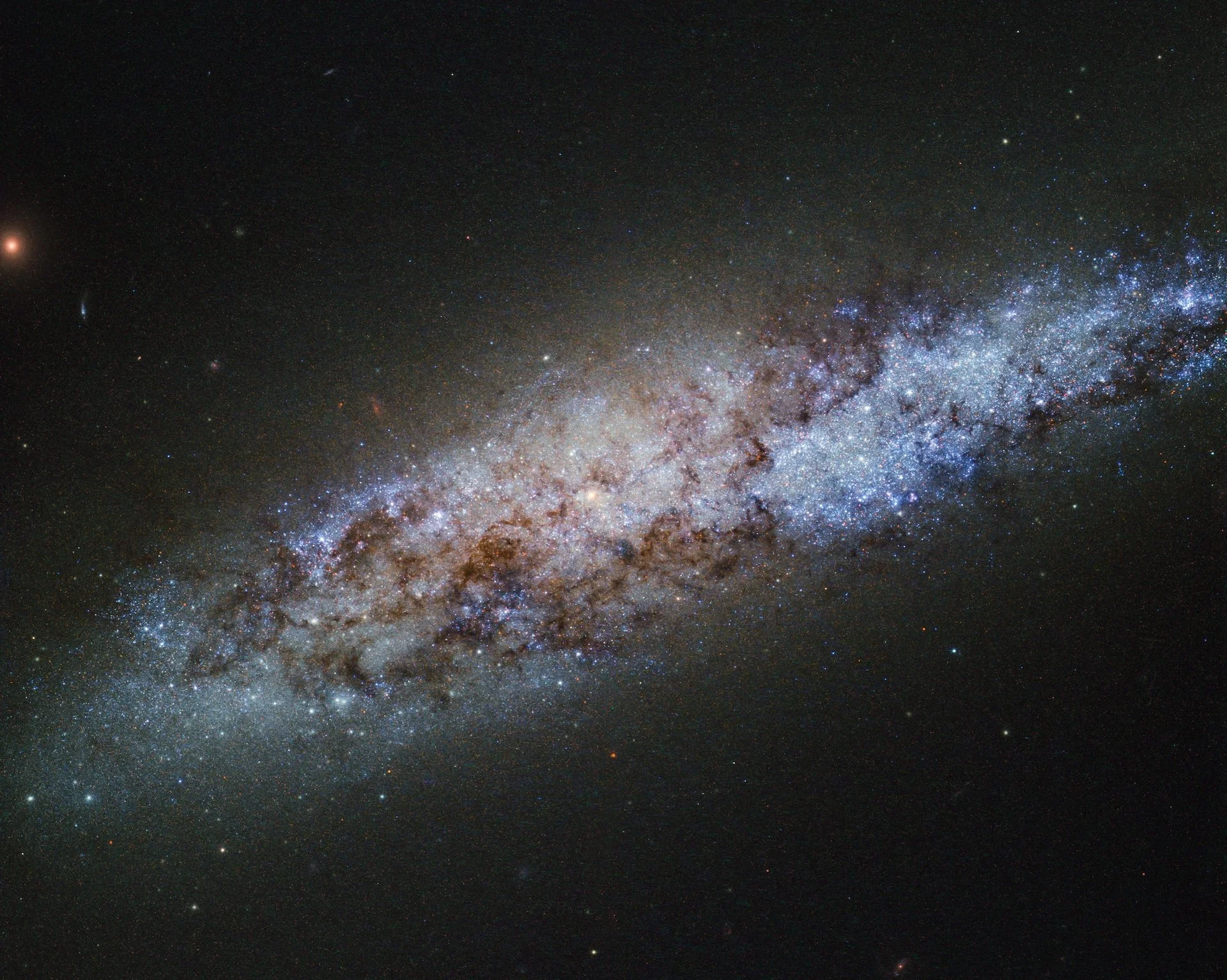
NGC 4605, a dwarf spiral galaxy about 16 million light-years away in Ursa Major. Credit: ESA/Hubble & NASA. Acknowledgement: D. Calzetti (University of Massachusetts) and the LEGUS Team.
Our role as humans and as architects must now be to restore the earth’s ability to continue its growth towards complexity and differentiation.
The second primary creative principle of the universe as identified by Berry is that of increased “subjectivity.” Together, every reality that makes up a part of the universe from atoms to galaxies and everything in between is not just a collection of objects but is a community of subjects. As subjects, we all have an inner dimension, an interior reality which not only reflects the diversity that surrounds us but reflects the original quantum gift of energy at the beginning of time. Our creativity as humans is informed by the diversity of subjectivity that is allowed to declare itself around us. Therefore, any human activity that contributes to the impoverishment of the natural world will then inevitably contribute to the impoverishment of our own interiority, our own sense of wonderment and awe. With every species that becomes extinct, every mountain that becomes scarred by deforestation, every river that becomes polluted with our industrial wastes, the diversity of the natural world that inspires our creativity as humans, and architects is diminished. Our own ability to survive as a species will depend to a great extent on the ability of all natural entities on the planet, both living and non-living, to develop their full potential apart from human influence as much as possible.
Thomas Berry’s third creative principle of the universe “is the communion of each reality of the universe with every other reality in the universe.” As mentioned before, we are an inextricably related community of subjects. This genetic interrelatedness of everything in the universe to everything else means that the universe is in dialogue with itself as a community. “Everything is intimately present to everything else.” The original bursting forth of energy at the beginning of time contained all the elements necessary for the evolution of the universe up to and including human culture and technologies. The potential for religion, liturgy, music, poetry, dance, art and architecture existed as part of that original expression.
This is why we are connected to the stars in the night sky and to all living and non-living realities on the planet, why they are deserving of our awe and reverence, and why we must celebrate them in our creativity.
Thomas Berry asserts that we need a functional spirituality to go with the functional cosmology emerging from the new epic of evolution, that we need to rediscover the natural world as sacred and as the primary revelatory experience of the divine, to adopt a primary loyalty to the entire Earth community of all living and non-living entities, and to commit to the progress of the full Earth community in all its integrity. He would attest that if we as architects become more aware of the spiritual dimension of creation, we will come to appreciate that our best spiritual practices will resonate with and be inspired by the numinous presence of the divine within both us and the rest of creation.
Just as we are derived from Earth’s creativity and flourish best when we act in ways that are in harmony with Earth’s dynamics, so too will our spiritual practices support our flourishing as architects and the flourishing of the rest of planetary life when they are in harmony with the spiritual dynamics of creation. Only then, Berry predicts, can we contribute to the healing of the Earth in all its life systems, forfeit our exploitive relationship to the Earth, and achieve a relationship with the Earth that is mutually enhancing. Only then will we contribute to the evolving universe story in ways that support the creative dynamics that have allowed that story to flourish over the past 13.8 billion years.

A mountain stream, Nikko, Japan. Photo: The Right Angle Journal.
Notes
1. Thomas Berry, Thomas Berry and the New Cosmology. Anne Lonergan and Caroline Richards, eds. Mystic, CT: Twenty-Third Publications, 1987.
2. The full text of his “Twelve Principles for Understanding the Universe and the Role of the Human in the Universe Process” appears in the appendix on pages 107–108.