My Architectural Journey
By Ryan Martin
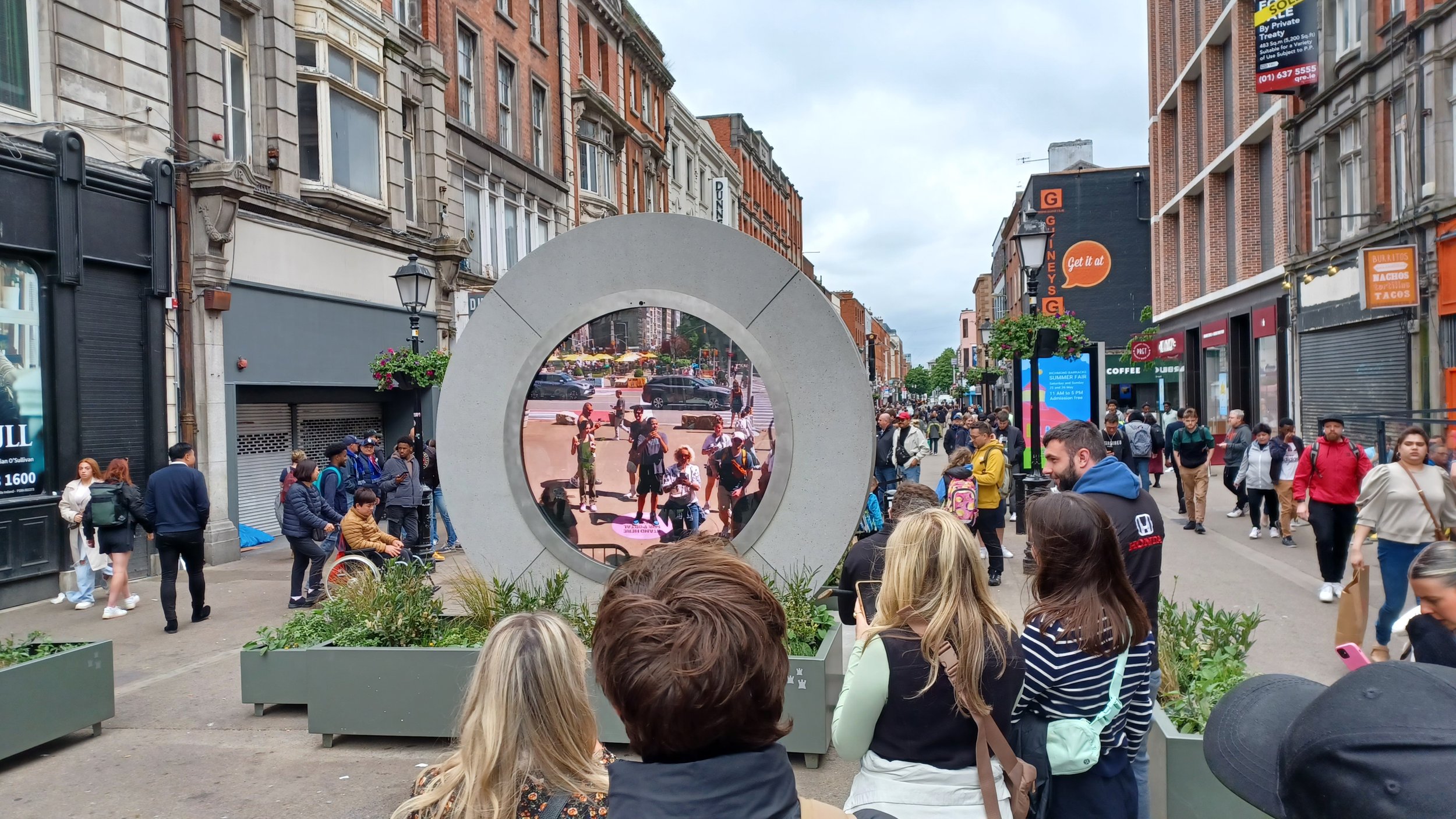
The New York-Dublin Portal, as seen from O'Connell Street, Dublin.
Photo: Suo Edits, 2024-05-22.
The career journey of every architect is unique, specifically designed by the individual that travels it. It will fluctuate with every decision. In spite of this, almost all journeys share similar features. There is the journey through school, the first job in the field, the moment an intern becomes licensed, and the first solo project. There is the first argument with a client, and the last, the first debate with a contractor, and the last, and the many discussions with fellow architects, regarding ideas and details—first and last.
Each writer in this journal has probably experienced every first I could imagine, and twice the number I could not. Each has a wealth of stories that I can only hope to experience one day. However, I have only just begun my architectural journey. I am a 25-year-old intern who has less than two years of practical experience in the architectural field. Most of the stories I will look fondly upon when I retire have yet to come. So I will not treat this essay as a chance to wow you with impressive stories or share some revolutionary ideas developed through my travels. Instead, I will tell you what I hope my journey becomes while I explore the field of architecture. I do not have the stories to tell yet, but that is an exhilarating prospect.
I hope I will get to see the completion of a thousand projects in my career, some as uninspiring as a boiler replacement, and others as expansive as an urban renewal that changes the very fabric of a community. Or perhaps even a project that I can’t even dream of today, like an object in space, or a planet design akin to something in “Ready Player One.” I hope that each of these projects results in a funny lesson or a unique tale that can be shared when I become a mentor and begin teaching the next intern. Maybe I can share a story of something ridiculous, like a bird stealing tools from a contractor to build a nest, or an unforeseen lesson on the value of always designing the direction of door swings. The best stories will be the ones that teach worthwhile lessons but also bring a smile to my face when I tell them. Perhaps, like learning the importance of always locking a porta-potty on every site or never standing between an industrial fan and a contractor (These are other people’s stories of actual events; details are available on request). Who’s to say; the lesson hasn’t happened yet, but it’s exciting all the same.
I hope that all the projects I work on will always be to the complete satisfaction of the client, the users, and especially the random passerby who just happened to notice the architecture. I hope that my projects will enhance the beauty of their place, both in function and in form, discovering new ways to create spaces for people to enjoy. Perhaps in some designs I will find ways to amaze—projects that surprise those who view them with a previously un-thought-of idea, like the Scoop in the UK or the Lotus in China. In these projects, I hope I will always find ways to maximize the client’s budget to ensure that it will not diminish the project.
Through all of my projects, both big and small, I hope I can create communities. That each building, new or even just renovated slightly, helps to develop spaces for people to come together, live better, and be happier. That my projects can be designed for people, instead of profit, finding new methods or repurposing existing ones, to create spaces for personal interactions. Perhaps in some designs I will find new options to connect people, like “The Portal” in New York and Ireland, or the “Victorian Pride Centre” in Melbourne. Even something as small as renovating local farmers’ market stalls. In these projects, I hope I will always find the missing puzzle piece that had been vacuumed up weeks ago, to create something that will surpass all expectations.
I have more concrete goals too. I hope that one day I will be given the opportunity to repurpose existing office buildings into residential districts that emphasize interactions, as I have explored in my thesis. In these buildings, I would ensure they are entirely self-sustainable, able to create “third” spaces, and can be easily repurposed for future renovations. Maybe a bit too specific? Perhaps, but I’m going to dream of it, anyway. It would be quite incredible if one day I could tell my grandkids that my design solutions helped to address the post-COVID housing crisis of the 2020s, as I believe it could. Or maybe I’ll develop a different thesis during my career that addresses problems that we haven’t faced yet.
Above all else however, aside from my aspirations, I hope that once my career is finished, after I’ve designed my last project, taught my last lesson, and written my last words, that I’m proud of every moment of it. I want to be proud of every last thing I’ve done. Be that large or small, wide or narrow, strange or basic. If I can look back on my career and say that I am proud of every moment of it, I will be happy.
This journey that I hope to embark on is optimistic, no part of me doubts that. There will be tribulations and barriers that will interrupt my progress. Who knows, by the end of my journey, I may not even be an architect. But this article is not meant to predict my future. It is simply a place to put my hopes and dreams of a better tomorrow. It’s a small meadow that I have created, which I hope to look back on in 5, 20, or even 40 years from now, having gained the experiences I crave now: a shrinking window to the past that I will hopefully be able to look back on with the same hope. I know that, simultaneously, all of my hopes and career aspirations are optimistic but I'm not worried about that. It has always been the job of the new architect to enter the profession with a belief in change for the better. The ultimate goal of this essay is to serve as a constant reminder for myself. To tell myself every single day that I do believe that this world can be better and that I can have a hand in making it so.