A Career is a Journey, not a Destination
By Gordon S. Grice, OAA, FRAIC
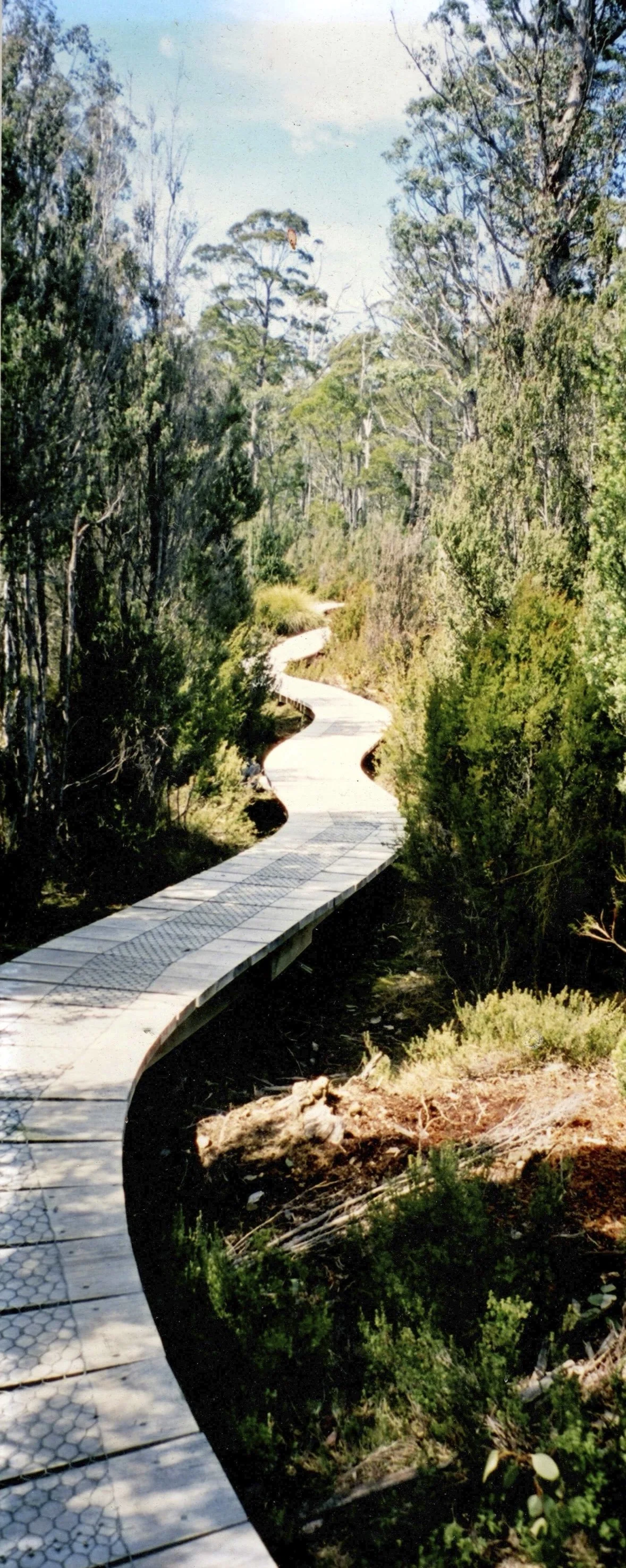
A hiking path in Tasmania.
Photo: the Author.
As a kid, I played with Minibricks, Meccano Sets, Tinkertoys and Canadian Logs, just like most kids in those days. Nothing about this suggested that an architectural career lay anywhere in my future. I had no plan to become an architect.
One small hint at architectural promise may have occurred when it was my turn to wash the dishes. I would lay down a dishtowel and then, instead of putting the wet dishes onto the drying rack, like I was supposed to do, I would build stylized structures by stacking them into towers—glasses and cups as columns, plates as floors and roofs, cooking utensils as sky-bridges—so that the kitchen table resembled a miniature city of the future. But in my mother’s eyes at least, these construction projects didn’t hint at a future career at all. Instead, they suggested a career to be avoided: professional dishwashing. It turns out that dishes don’t dry properly when they’re piled one on top of the other. My early city-planning career came to a crashing finale when, due to my poor grasp of structural design principles, my towers toppled and dishes broke.
Full-size architecture, or anything to do with full-size architecture, simply wasn’t part of my vocabulary. It wasn’t taught (or even discussed) in school, and I had never, in my entire life, met an actual architect. Then, in my last year of high school, I had to decide on a university program. I needed it to be something special, maybe even exotic, so that I didn’t wind up in a liberal arts course and spend the rest of my life teaching or juggling paper. I wanted to find a “respectable career.”
No one had ever explained to me that a “career” (from Lat. carraria, Fr. carrière, a roadway), whether respectable or otherwise, wasn’t something you landed on; it was a road you travelled.
There was a TV program, Mr. Ed, whose two main characters were an architect named Wilbur Post, and the eponymous Mr. Ed, a talking horse. Wilbur spent his daylight hours chatting with his horse in a studio that doubled as Mr. Ed’s stable. The walls were decorated with architectural renderings, but there was no evidence that Wilbur, who didn’t seem particularly bright, ever did any real work. This led me to think, hypothetically, about a career in architecture. However, as my only introduction to the profession, Mr. Ed presented mixed messages: a) an architect doesn’t have to be that clever or work that hard, which may be a good thing, but b) an architect may be subject to delusions or psychotic episodes, such as conversing with, and taking advice from, a talking horse, which was maybe not a good thing. In either case, architecture didn’t seem like a respectable career.
I liked to draw, so my high school art teacher Miss Murphy said maybe I should consider architecture, but I was still undecided. I mentioned my indecision to a customer at the gas station where I worked weekends, who happened to be an architect. In fact, he was the only architect I had ever met. He told me that architecture was a really good profession because it gave you lots of opportunities to travel. That seemed paradoxical: I knew that buildings didn’t move, so I had always imagined that architects didn’t, either. But it got my attention.
He meant physical travel, of course, and for me, that has worked out as promised. My professional journeys have taken me, all over the world. But the bigger surprise for me has been the metaphorical journey: architecture wasn’t the destination; it was the port of embarkation.
Let’s start with the beginning of the journey: architectural education. In general, education is a journey unto itself, and one that is lifelong. But my formal education in architecture was less like a journey, and a lot more like packing for a journey. And as often happens, the things I was told I would need on the journey proved woefully inadequate for the actual journey. Apparently, I was going to need some history, some theory, some structural design, specification writing, a whole lot of architectural design studio—all useful things, to be sure. But what about marketing, writing, accounting, psychology, risk assessment, etc., etc.? And would I really need to pack plumbing and electrical systems into my suitcase of knowledge? There are engineers for that.
Inevitably, I graduated and embarked on my architectural career. By now, I had come to understand that this was in fact, going to be a journey, so I would need a plan and a destination. That was easy: Make a decent living, raise a family, live in an interesting house of my own design (possibly, on top of a hill), drive a foreign car, then retire to a tropical island.
But I got it backwards, right from the start.
The idea of retiring to a tropical island was so appealing to me that I decided to do it almost right away. After three years working in the city, I accepted a job with a firm in Bermuda that promptly relocated me to their office in the British Virgin Islands. To me, this constituted a tropical island “retirement” in an unorthodox sense: I would enjoy the benefits of retirement, while still earning a living. The best of both worlds. It sounded perfect.
But this arrangement introduced an unforeseen complication. As an architectural intern in the city, my custom had been to appear busy, even when I wasn’t. This was meant to show my boss, my parents and my friends that I was leading a productive life. But in the West Indies, it was the other way round: As a newly licensed architect (I had signed on with the RIBA), it was often necessary, professionally and socially, to appear as though I was not busy, even when I was. So, it was like a fake retirement. My employer and our clients didn’t care about my retirement issues, real or simulated. Deadlines were deadlines. But friends, especially those visiting from Canada, certainly did. What’s the point in living in paradise, if you have to be tied to your job? Let’s go to the beach.
I was finding it just as stressful to not appear busy while trying to get work done as it had been to appear busy when I wasn’t. So much for retirement to a tropical island.
During my years in the BVI, I started a family and renovated two houses to live in. The first of those houses was, in fact, on top of a very high hill, and had an impossibly breathtaking view of a palm-lined beach below, with a vista of a turquoise island-dotted tropical sea that merged with the sky at the horizon. So, I was able to realize part of my retirement dream, but only in the evenings and on weekends.
My island sojourn convinced me of two things. First, living on top of a tropical hill has its downside. It can mean slogging up and down a steep, dangerous, rutted road every day, jarring the body and the senses. I owned a “foreign car,” but it was a $600 beat-up, stripped-down long-wheelbase Land Rover, with no discernible suspension system. Second, retirement is overrated. There I was, trying not to look busy, surrounded by people who had retired to the tropics to spend days on end with nothing much to do except acquire leathery skin and slide into benign alcoholism. I couldn’t for the life of me see the point. But my five years of living in the tropics, followed by a further dozen years working there periodically, did satisfy the promise that architecture would allow me to travel, geographically. And, unknown to me at the time, it represented the first port-of-call on my complicated career journey.
After I had graduated from architecture school, and just before finishing my registration courses and leaving the city to live in the sun, I had worked briefly in an architectural office with a colleague whose sideline was architectural illustration. Because I liked drawing, I was fascinated by this—to me—obscure architectural digression. He gave me some professional tips and, importantly, a lot of encouragement. He had regular clients and lots of work, so when the office began laying people off, he quit drafting to start drawing full-time. And I left for the tropics.
In the West Indies, where work generally tended to be less by-the-book, there were lots of opportunities for drawing and sketching as part of the architectural process—even creating construction documents. (One of my colleagues did beautiful working drawings, freehand, with notes written longhand that sometimes verged on poetry.) So, I started doing more freehand drawing—design sketches, observational drawings and renderings. I met a commercial illustrator from New York who was visiting a painter who lived in a house on the beach below my house. He showed me how to use a pen for freehand drawing, and inspired by architects like Bertram Grosvenor Goodhue, Arthur Gupthill, Sydney R. Jones, Chester B. Price and others, pen-and-ink became my rendering method of choice.
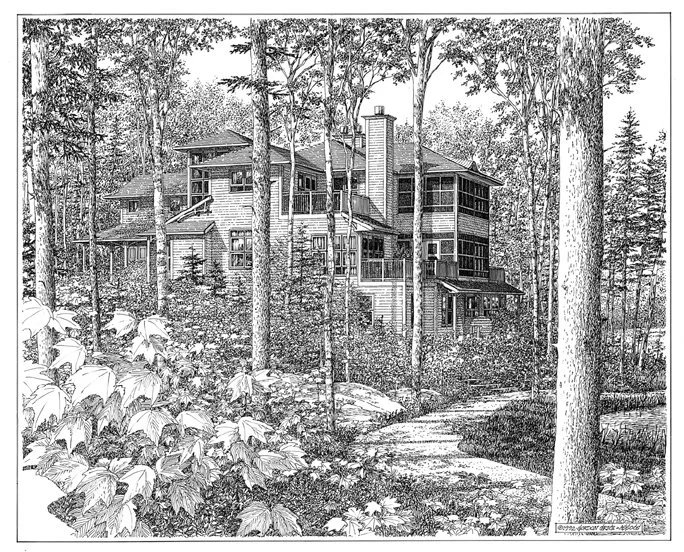
Deerhurst Condominiums, Zeidler Partnership Architects.
Pen-and-ink drawing: the Author.
When I returned to the city, I was an illustrator. I borrowed a desk in the downtown architectural office of Roger du Toit and Ed Galanyk, who fed me illustration work on a regular basis. This marked the next leg of my career journey. I began working fulltime as an illustrator, and a dozen years later, I abandoned architectural practice entirely. Illustration work was irregular and, like architecture, it often involved all-nighters and 14-day weeks chained to a board, but I was much happier. As I told anyone who asked, I got to work with a lot of amazing architects, and only on the best part of the project: concept and design. I even got to exercise my design chops from time to time. Also, I was earning a decent living, which surprised me as much as everyone else. You can earn a living doing that? And, just as important, I got to travel for my work: Boston, Minneapolis, St. Maarten, Marrakech, Copenhagen, Cairo.
I was a dues-paying OAA member, but now an “architect without licence,” which, you have to admit, sounds pretty romantic.
When I launched my architectural illustration career, back in the city, I met a few others who were practising the same craft, each in their own unique way. Our skills were “self-taught” and personal, and none of us had professional connections beyond the city limits. Then, an American architectural illustrator made the trip north to give a brief talk. The illustrator, the inestimable Paul Stevenson Oles, had written a book on architectural illustration—in fact it was called Architectural Illustration—which I had been using as a bible and a DIY instruction manual. My copy of the book was underlined and dog-eared. I knew that I would never be able to draw like that, but I could see that there was a higher standard that I might aspire to. In his presentation, Steve (as I came to know him) told us that he and two others had recently formed an organization called the American Society of Architectural Perspectivists, or ASAP (a reference to the deadline that most illustrators face), and he was hoping to drum up membership in Toronto, where, as it turned out, there was an abnormally high number of architectural illustrators. I didn’t take much convincing. I joined.
At the time, ASAP was planning its next convention In Chicago. I went to the windy city to see what the organization was all about and got a huge surprise. The convention was more like a family get-together, and I was immediately welcomed as part of the family. I stayed in contact with the people I met in Chicago and, in three short years, I got elected ASAP President. Exactly how this happened is still a bit of a mystery to me, but fate must have had something to do with it: Assuming there might be a role for me to play in the organization, I may as well start right away.
As ASAP president, I organized the seventh annual convention and drawing competition (Architecture in Perspective—AIP), both to be held in Toronto. The three jurors I invited to participate were: Olympia and York’s Ron Soskolne, Diamond & Schmitt’s Don Schmitt, and legendary designer/illustrator Syd Mead, who flew in from Pasadena for the jury and the conference.
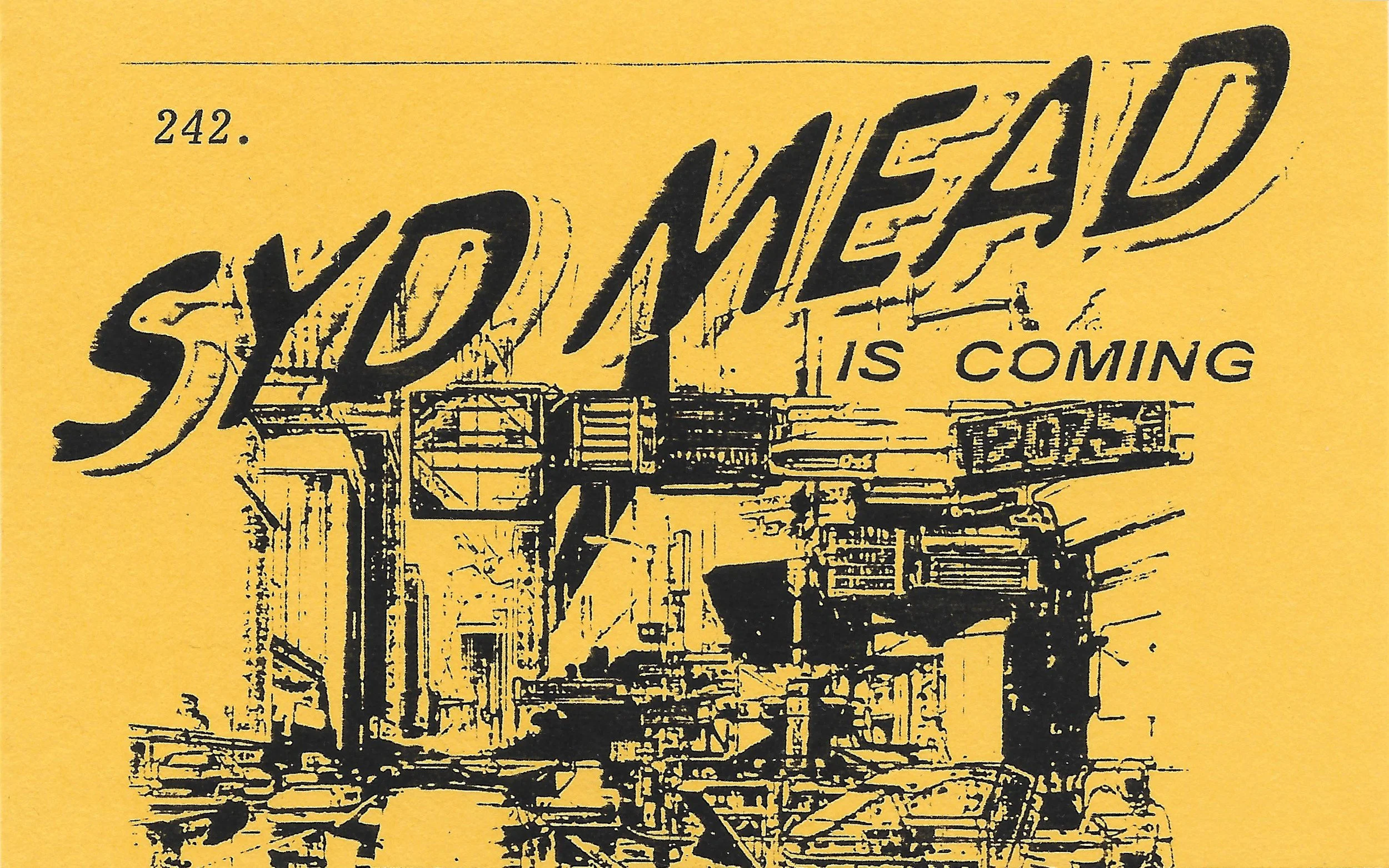
Card announcing Syd Mead’s presentation.
Image: the Author.
As it happened, just before our conference, one of the big downtown movie theatres was showing a special re-release of Blade Runner (not the Final Cut, released several years later), which was a cult classic and a remarkable creative achievement for its concept designer, Syd Mead. Since we needed to find the money to pay Syd for his second trip to the city, I printed up little cards announcing the lecture at the King Edward Hotel and handed them out to the Syd Mead die-hards in the ticket line. We collected $10 (maybe $20) at the door, made enough to cover costs and Syd delivered his astounding presentation to a full house.
My career journey as an architectural illustrator and as a deeply embedded member of ASAP was set and continues to this day. ASAI (the name was changed in 2001) is now an international organization, and Since AIP7, my work with them has taken me all over the world, from Bear Run, Pennsylvania to Hobart, Tasmania, with Tokyo, Los Angeles, London, College Station, Texas, and two dozen other places, large and small, in between. I have met many incredible people and made many friends. We’re currently planning AIP 40, in Washington DC.
But getting back to AIP7 and the Toronto convention: After that, my career journey took another unexpected turn.
I was contacted by Arthur Furst, an agent at Rockport Press, which was a large publisher in the US. He was creating a portfolio book on architectural illustration and needed an editor. One of his contacts in the field had recommended me. Editor? How did they imagine that I fit that description, even remotely? Well, Arthur said, all I had to do was get illustrators to subscribe to the book by buying pages and tear-sheets. Any writing required, they would do by themselves. It sounded like an interesting challenge. I had been the editor of yearbooks in public school and high school, so I guessed I had some qualifications. It didn’t seem that hard, and there was money in it—American dollars.
I was beginning to get the picture. When you’re on a journey, geographical or metaphorical, and your destination is unclear or unknown, it may be wise, even necessary, to revise your itinerary, since you have nothing to lose, and you might enjoy new experiences and new surprises. People do this all the time. I took the editing job, and it turned out so well that I went on to edit two more volumes. The Art of Architectural Illustration 003 was even translated into Chinese. But none of that really made me an editor. At least, I didn’t think so.
However, there was a person who did think so. That was Phyllis Clasby at the Ontario Association of Architects. The OAA had started a member-benefit publication, and they wanted it to go quarterly. They needed an editor and I was at the top of the list. It wasn’t so much, “Was I interested?” But more like, “How soon could I start?”
How did I even get on a that list? Well, to begin with, Phyllis explained: “You’ve edited books, haven’t you?” (by this time, I had been involved with maybe a dozen books as a sort of “editor”.) “A journal isn’t much different” (in some ways true, but I wasn’t totally convinced at the time). This reminded me of my conversation with Arthur Furst at Rockport. When I asked him why he thought I could edit a book about illustrations, he had said “You’re an illustrator aren’t you? Editing isn’t that much different.” This had sounded preposterous, but it also turned out to be sort of true.
It was an unusual job interview that consisted of my offering many reasons why maybe I wasn’t the best choice, and Phyllis countering with reasons why I was. There were no available OAA members with editing credentials. I knew a lot of architects. I could look at the profession from the outside, as a non-practitioner. Then the zinger: Drawing, editing, and even writing have a lot in common. That weird hypothesis again. You hear something often enough and you start to believe it. And so began the third leg of my career journey—as an actual editor—that would stretch on for 20 years, and result in 81 issues of OAA Perspectives, and continues to this day.

OAA Perspectives Cover, final “sundown” issue, V25, No1.
Courtesy of the OAA.
Writing quickly became a part of the editing package. When I edited the Illustration books, Arthur had told me I could write a brief introduction if I felt like it. I did feel like it, and I liked doing it. The OAA journal also required writing, and over the succeeding years, writing turned out to be another leg of my tortuous career path. Although writing and editing didn’t constitute architectural practice in any conventional sense, writing about architectural subjects and editing the written work of architects took me to the very heart of the profession. The main theme of the OAA journal was: “What does it mean to call yourself an architect?” My years in Perspectives taught me more about the depth and breadth of the profession than I would have imagined possible.
OAA Perspectives was a wonderful journey, but it didn’t provide fulltime occupation, so I kept my day job as an illustrator, and started including more writing in my activities. For a short time, I wrote book reviews for an online agency. One of those reviews took me to Kyoto, Japan, where I spent an afternoon in a Buddhist Temple garden. That garden, that afternoon and the book about it that I was reviewing have stayed with me for more than a dozen years now and have coloured my views about journeys in general. It was the Buddha, among others, who said that happiness is a journey, not a destination.
I finally gave up my freelance drawing career entirely (maybe not entirely: see The Right Angle Journal, Public Space: “Sense of Place”) when I took a salaried position as an illustrator, then writer, then artisic director (career leg number five?) with Forrec, a firm that designs entertainment environments. It was there that I learned the importance of storytelling, not just in writing, but in drawing, in architecture, and in just about every artistic endeavour. As an adjunct to my job, I met an international group of “theme park theorists,” who entrenched in me the importance of narrative in designing architectural space. I joined them to deliver a paper at a conference in Mainz, Germany, whose “theme” was “Time and Temporality in the Design of Theme Parks and Immersive Environments.”
Ironically, Mainz is where Johannes Gutenburg invented the moveable-type printing press that introduced the printed publication—hence, general reading—to the world: the very thing that Victor Hugo believed would spell the end of architecture. The University where we presented our papers, in fact, was named in Gutenburg’s honour. It was becoming clearer to me that the thread that connected the various legs of my career journey was the communication of architectural ideas, by any and all means available.
It’s a journey that has taken me from architectural practice to illustration, editing, publishing, writing, teaching, public speaking, theme park design, then back to writing, but all the while, my architectural mindset has travelled with me. When I left architecture school, with my inadequate baggage, I had made the common mistake of thinking that I could set a career course and stick to it. Many people succeed in doing this and lead extremely successful lives to the great benefit of mankind. Among this group, you can count many architects. Even within architectural practice, there are many paths to explore, and the number of paths increases almost daily.
Today, I do freelance writing, I edit this online journal, I organize the jury for ASAI competitions and compose the AIP catalogue, and I work with an insurance company. This latest leg to the career journey may appear to be an outlier in an otherwise connected path. What can professional liability insurance possibly have to do with artistic expression, or creativity, or architectural communication, of any kind?
As you might suspect by now, architectural communication has no boundaries. Among other things, it encompasses drawing, writing, editing, speaking, and most especially storytelling. Storytelling for me has included writing backstories for experiential spaces, and writing about architectural ideas, projects, journeys and adventures. It now includes creating scripts for professional practice insurers that tell the tales of architects who have gotten themselves into trouble and out again, with the help of Pro-Demnity, their insurer. I can’t write these scripts without thinking about my journey, and the many paths that architecture can take. Some of these lead to creating wonderful spaces, others to presenting architectural ideas through drawing, writing and editing, and still others, wouldn’t you know it, lead you into and out of expensive litigation, because creative adventure involves some risk.
You can hear some of these stories at https://prodemnity.com/risk-education/#case-studies.*
Now that I’ve briefly described my journey, you might be wondering, exactly what kind of a journey is that? Simple. It’s an architectural journey, and so far, there’s no itinerary or final destination in sight.
*The original stories, on which the scripts have been based, were written by David Croft for Pro-Demnity Insurance.