From Passage To Place: The Gallery Of Human Migration
By Rocco Maragna, FRAIC
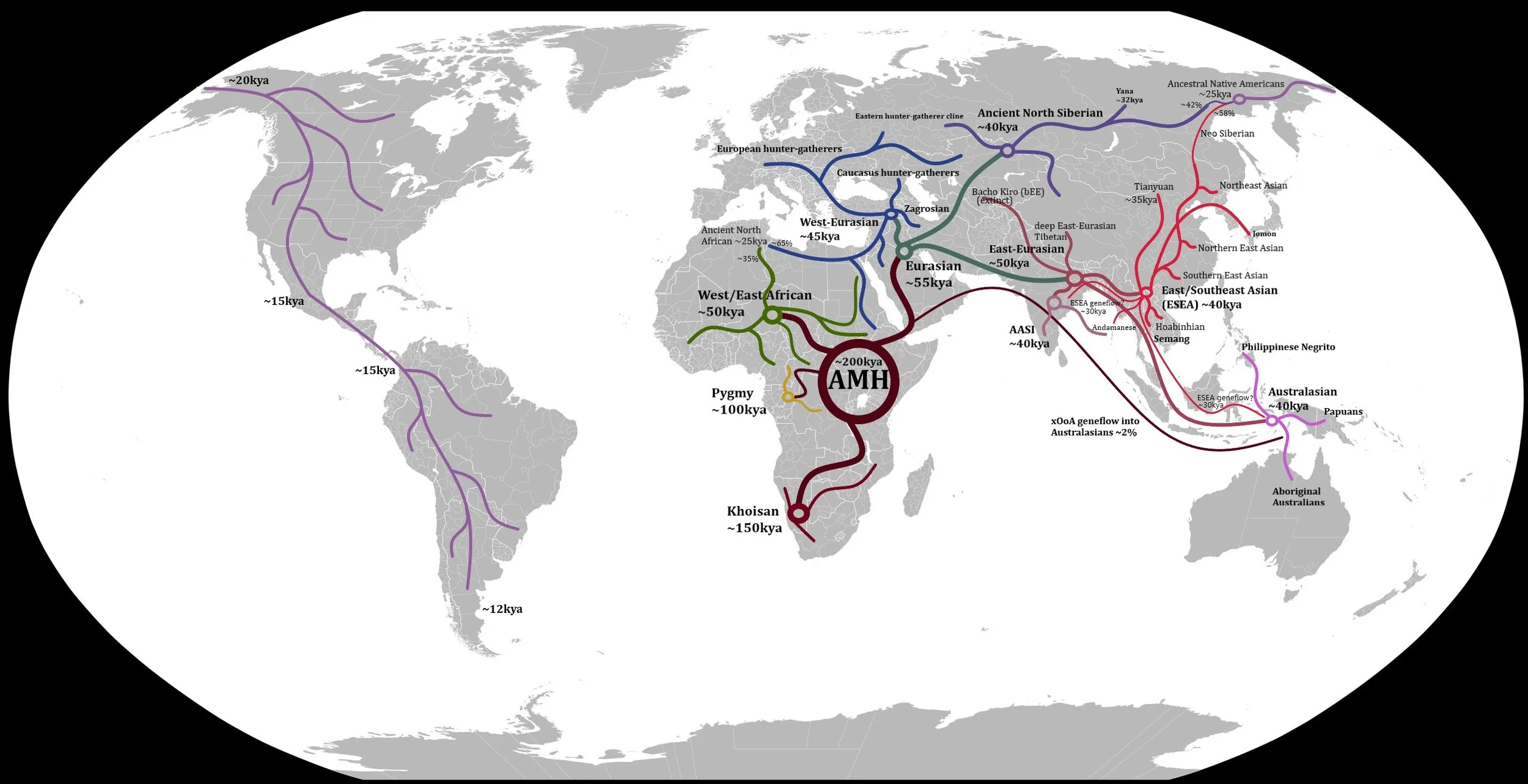
Human migration routes following Out-of-Africa.
Journeys shaped by migration generate thresholds, sequences, and transformations. They reorganize perception, reconfigure belonging, and participate in the construction of identity over time. These journeys cannot be reduced to discrete or episodic events; rather, they operate as structuring conditions that continuously mediate the relationship between individuals and their environments. Through this mediation, space acquires meaning as lived architecture rather than abstract form. Migration calls forth movement, and in that call lies the first threshold—the moment when possibility emerges and the trajectory begins.
Migration unfolds in stages that resonate with architectural practice. BECKONING signals the call toward new possibilities, akin to schematic design, where the trajectory of a project is first imagined. BEGINNING corresponds to design development, negotiating constraints and elaborating relationships, much as the migrant charts their initial steps in unfamiliar terrain. BECOMING parallels the production of working drawings, the concrete articulation of ideas into actionable form, echoing the transformative adaptations of those in transit. Finally, BELONGING aligns with realization or inhabitation, when vision and presence converge, and both space and identity are enacted. In this way, the 4 Bs offer a conceptual bridge linking migration and architecture as processes of continuous formation.
From this perspective, architecture may be understood not merely as the production of form, but as the formation of experience through movement. This aligns with phenomenological approaches to space, as articulated by Juhani Pallasmaa, where perception, memory, and embodiment are central to how space is constituted. Migration amplifies these conditions, making visible the processes through which space is continuously interpreted, traversed, and re-authored.
These dynamics find particular expression in Canada, a contemporary crucible of migration. Within this context, I—both migrant and architect—initiated the Gallery of Human Migration, conceived as a virtual spatial construct. It is not a repository of fixed histories, but an open and evolving environment. Each contribution is a lived moment that connects with others, forming a collective space of shared experience.
The Gallery establishes a platform on which individual narratives—memories, trajectories, cultural expressions, and artistic works, including drawings—are brought into relation. Contributions are unified by migration as their guiding principle. Through descriptive narratives or reflective accounts, each piece transforms into a virtual threshold, inviting users to traverse and assemble an emergent field of experience where individual journeys collectively produce a shared understanding of space, identity, and belonging.
Representation here exceeds documentation. It becomes constructive. Drawing, in particular, operates as a mediating practice, translating memory into spatial form and allowing past and present to coexist. These fragments accumulate, creating thresholds, corridors, and sequences that guide understanding without prescribing it.
In this sense, the Gallery resonates with what Henri Lefebvre described as the “production of space,” wherein space is continuously generated through social practice. The Gallery extends this proposition into a virtual domain, where space emerges through the accumulation and interaction of lived accounts. What results is not a fixed construct, but a field condition—dynamic, open, and incomplete. It reflects the nature of migration itself: arrival provides shelter not as structure, but as space for transformation, adaptation, and emerging belonging.
For architects, this has direct implications. Space is never neutral, nor fully determined by form alone. It is continually redefined through the lives that inhabit it—lives shaped by movement, memory, and adaptation. By engaging with migration, one encounters one of the fundamental processes through which space is produced. The Gallery renders this legible. It allows structure to emerge through participation. It functions as an archive and a project simultaneously: preserving individual experiences while remaining an open, generative system that continually reshapes its collective field.
In the Gallery of Human Migration, every story, drawing, and memory becomes a threshold, shaping spaces that exist as much in thought and imagination as in any physical form. Here, the poetics of space are lived: memory and movement construct intimate thresholds, and, as Louis Kahn observed, architecture is the thoughtful making of spaces. Migration, like architecture, is a continuous act of creation—an ongoing negotiation of identity, place, and belonging.
These stories of migration can be accessed on the Gallery of Human Migration website: www.galleryofhumanmigration.org)